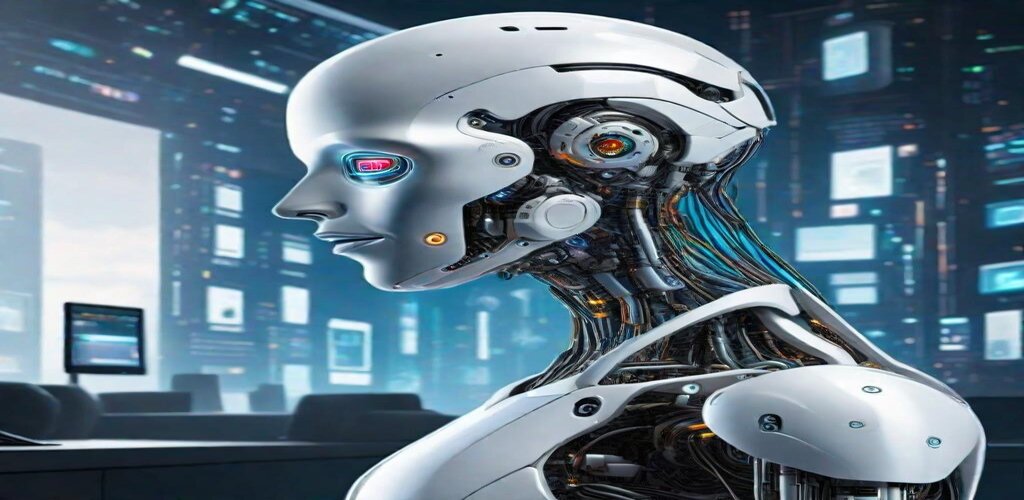
Introduction: The AI Revolution Has Arrived
Artificial Intelligence is no longer science fiction—it’s the technology transforming every aspect of our daily lives in 2025. From the AI assistant writing your emails to the algorithm recommending your next Netflix show, AI has become ubiquitous. This comprehensive guide explores what AI is, how it works, its current applications, and what the future holds.
Understanding Artificial Intelligence: The Basics
What is AI?
Artificial Intelligence refers to computer systems that can perform tasks typically requiring human intelligence. These tasks include visual perception, speech recognition, decision-making, language translation, and problem-solving. Unlike traditional programming where humans explicitly code every rule, AI systems learn patterns from data and improve their performance over time.
Modern AI encompasses several technologies: Machine Learning (ML), where systems learn from data; Deep Learning (DL), which uses neural networks to process complex patterns; Natural Language Processing (NLP), which enables computers to understand human language; and Computer Vision, which allows machines to interpret visual information.
The AI Hierarchy
Narrow AI (Weak AI) – Current AI systems excel at specific tasks but can’t generalize beyond their training. Your smartphone’s face recognition, ChatGPT’s text generation, and recommendation algorithms are all narrow AI. These systems are incredibly powerful within their domain but can’t transfer knowledge to unrelated tasks.
General AI (Strong AI) – This hypothetical AI would match human cognitive abilities across all domains. AGI could learn any intellectual task a human can, transfer knowledge between domains, and reason about unfamiliar situations. Despite recent advances, true AGI remains years or decades away.
Superintelligence – An AI system that surpasses human intelligence in all domains. This theoretical concept drives both excitement and concern in the AI community. Superintelligence could solve humanity’s greatest challenges or pose existential risks, depending on how it’s developed and controlled.
How AI Works: Machine Learning Explained
Traditional Programming vs. Machine Learning
Traditional programming requires developers to explicitly code rules: “If temperature > 30°C, then it’s hot.” This approach breaks down for complex problems with millions of variables. Machine learning flips this paradigm: instead of coding rules, you provide examples, and the AI discovers patterns.
For instance, to create an image recognition system, you don’t program rules for identifying cats. Instead, you show the AI thousands of cat images labeled “cat” and thousands of non-cat images labeled “not cat.” The AI learns visual patterns that distinguish cats from other objects.
Neural Networks: The Brain-Inspired Architecture
Modern AI relies heavily on neural networks, computational models inspired by biological brains. These networks consist of layers of artificial neurons (nodes) connected by weighted links. Information flows through the network, with each layer extracting increasingly abstract features.
Deep learning uses neural networks with many hidden layers (hence “deep”). A deep learning image classifier’s first layers might detect edges and colors, middle layers recognize shapes and textures, and final layers identify complete objects like faces or cars. These hierarchical representations make deep learning extraordinarily powerful.
Training AI Models
Training an AI model involves feeding it vast amounts of data and adjusting its internal parameters to minimize errors. This process, called gradient descent, iteratively tweaks millions or billions of parameters until the model performs well. GPT-4, for example, was trained on hundreds of billions of words from books, websites, and documents.
Training large AI models requires enormous computational resources. GPT-4’s training reportedly cost over $100 million in computing power. This massive investment creates a competitive moat around frontier AI systems, though smaller, more efficient models are rapidly improving.
AI Applications in 2025: Transforming Industries
Creative AI: Generative Models Revolution
Generative AI has exploded in capability and adoption. ChatGPT, Claude, and Gemini can write essays, code, analysis, and creative content at human-level quality. These large language models (LLMs) understand context, follow instructions, and engage in nuanced conversation.
Image generation tools like DALL-E 3, Midjourney, and Stable Diffusion create photorealistic images, artwork, and designs from text descriptions. Professionals use these tools for rapid prototyping, marketing materials, and creative exploration. Video generation AI can now create realistic short videos from text prompts.
Music and audio AI generates original compositions, clones voices with seconds of audio, and produces podcast-quality speech. These tools democratize content creation but raise questions about authenticity and intellectual property.
AI in Healthcare: Saving Lives
Medical AI systems diagnose diseases from medical images with accuracy matching or exceeding human experts. AI analyzes X-rays, MRIs, and CT scans to detect cancers, fractures, and abnormalities. Early detection through AI screening programs saves countless lives.
Drug discovery AI accelerates pharmaceutical research by predicting molecular properties, identifying drug candidates, and optimizing clinical trials. What once took years can now happen in months. AI-designed drugs are entering human trials, potentially revolutionizing medicine.
Personalized medicine uses AI to analyze genetic information, medical history, and lifestyle factors to recommend tailored treatments. This precision approach improves outcomes while reducing side effects and costs.
Autonomous Vehicles: The Road Ahead
Self-driving technology continues advancing, with companies like Tesla, Waymo, and Cruise operating autonomous taxis in select cities. AI processes data from cameras, radar, and lidar to navigate roads, avoid obstacles, and predict pedestrian behavior.
While fully autonomous vehicles aren’t universally available, advanced driver assistance systems (ADAS) using AI prevent accidents daily. Features like automatic emergency braking, lane keeping, and adaptive cruise control rely on computer vision and prediction algorithms.
The transportation sector’s transformation extends beyond cars. Autonomous trucks are beginning long-haul routes, drones deliver packages, and warehouse robots orchestrate complex logistics operations.
AI in Business: Productivity and Automation
Customer service AI powers chatbots that resolve common inquiries instantly, reducing wait times and costs. Advanced systems handle complex requests, escalating only unusual cases to human agents. Natural language understanding makes these interactions increasingly natural.
Predictive analytics AI forecasts demand, optimizes inventory, and identifies business opportunities. Retailers use AI to prevent stockouts and overstock situations. Financial institutions detect fraud in real-time, saving billions annually.
Marketing AI personalizes customer experiences, optimizes ad campaigns, and generates content. Email subject lines, product recommendations, and dynamic pricing all rely on machine learning algorithms maximizing engagement and revenue.
The Dark Side: AI Challenges and Risks
Bias and Fairness
AI systems learn from historical data, which often contains human biases. Hiring algorithms trained on past decisions may perpetuate discrimination. Facial recognition systems show racial and gender disparities in accuracy. Criminal justice algorithms have raised concerns about fairness in sentencing and parole decisions.
Addressing bias requires diverse datasets, careful model evaluation, and ongoing monitoring. However, defining “fairness” itself is complex—different fairness definitions can conflict, requiring difficult tradeoffs.
Privacy and Surveillance
AI enables unprecedented surveillance capabilities. Facial recognition can track individuals across cameras, behavior analysis predicts actions, and data mining reveals intimate details from seemingly anonymous information. China’s social credit system demonstrates AI’s potential for mass surveillance.
Western democracies grapple with balancing security and privacy. Law enforcement uses AI to solve crimes, but civil liberties groups warn about erosion of privacy rights. Clear regulations and oversight mechanisms are essential.
Deepfakes and Misinformation
AI-generated synthetic media creates convincing fake videos, images, and audio. Political deepfakes could influence elections, fake celebrity endorsements deceive consumers, and synthetic pornography victimizes individuals. Detecting deepfakes becomes harder as generation quality improves.
AI also generates text misinformation at scale. Bot networks create fake social media accounts, write fake reviews, and spread propaganda. Combating AI-generated misinformation requires both technical solutions and media literacy education.
Job Displacement
AI automation threatens millions of jobs. Routine cognitive work—data entry, basic analysis, customer service—faces automation. Even creative and knowledge work isn’t immune, as AI writes code, designs graphics, and analyzes legal documents.
While AI creates new jobs (AI trainers, prompt engineers, AI ethics specialists), the transition may be painful. Reskilling programs, education reforms, and potentially universal basic income are being debated as society adapts.
The Future of AI: What’s Next?
Multimodal AI
Future AI systems will seamlessly process text, images, audio, and video simultaneously. GPT-4V already combines vision and language, but next-generation systems will understand video, create interactive 3D environments, and orchestrate complex multimedia projects.
AI Agents and Robotics
Current AI is reactive—it responds to prompts but doesn’t take independent action. AI agents will pursue goals autonomously, breaking complex tasks into steps, using tools, and adapting strategies. Combined with robotics, these agents will perform physical tasks in homes, factories, and hospitals.
Artificial General Intelligence
While predictions vary wildly, many AI researchers believe AGI could emerge within 10-30 years. AGI would match human cognitive flexibility, learning new skills rapidly and transferring knowledge across domains. This breakthrough would be humanity’s most significant technological achievement.
Quantum AI
Quantum computers could revolutionize AI by solving currently intractable problems. Quantum machine learning algorithms might enable AI to discover new scientific principles, optimize complex systems, and break current encryption. This technology remains experimental but progresses steadily.
How to Prepare for an AI-Powered Future
Develop Complementary Skills
Focus on skills AI can’t easily replicate: creativity, emotional intelligence, complex problem-solving, ethical reasoning, and interpersonal communication. These uniquely human capabilities become more valuable as AI handles routine tasks.
Learn to Work With AI
AI literacy is becoming as important as computer literacy. Learn prompt engineering, understand AI capabilities and limitations, and experiment with AI tools. Those who effectively leverage AI will have significant advantages over those who resist it.
Stay Informed
AI advances rapidly. Follow reputable AI news sources, take online courses, and experiment with new tools. Understanding AI helps you adapt to changes and seize opportunities.
Conclusion
Artificial Intelligence is transforming human civilization at an unprecedented pace. While challenges exist—bias, privacy concerns, job displacement—AI’s potential to solve humanity’s greatest problems is immense. From curing diseases to addressing climate change, AI tools amplify human capabilities.
Success in the AI age requires balanced perspective: neither utopian enthusiasm nor dystopian fear. By understanding AI, engaging with its development responsibly, and adapting our skills and institutions, we can harness its power while mitigating risks. The AI revolution isn’t coming—it’s already here. The question is how we’ll shape it.